
Om is the whole of this universe. All that was, all that is, and all that will be is Om.
– Mandukya Upanishad
Mental health awareness is steadily becoming a global priority in the 21st century. But our society has started using terms like anxiety and depression rather lightly, and now any uneasiness or discomfort that one experiences falls under the umbrella of either anxiety or depression. But do we truly know the difference between anxiety and depression? This article will help you understand the real meaning of anxiety and depression, what they really mean for us, and explore how practices such as chanting mantras can help us manage our emotions.
Anxiety is the body’s emotional and physical reaction to stress, fear, or the unknown; anxiety includes worry and nervousness. The emotional and physical symptoms of anxiety may include a rapid heartbeat, shallow breathing, restlessness, tension, and persistent feelings of worry or fear.
Depression is a mood disorder characterized by persistent feelings of sadness, emptiness, irritability, and loss of interest, accompanied by physical and cognitive changes that significantly affect a person’s ability to function effectively.
Chant Your Way to Emotional Balance
From ancient to modern traditions, chanting is practiced worldwide. Mantras in the Sanskrit language were first developed within the Vedic religion. In ancient religions such as Hinduism and Buddhism, a mantra is a sacred utterance (syllable, word, or verse) considered to possess mystical or religious efficacy. Various mantras are spoken aloud, muttered, or merely sounded internally in one’s thoughts, and they are either repeated continuously for some time or sounded just once.
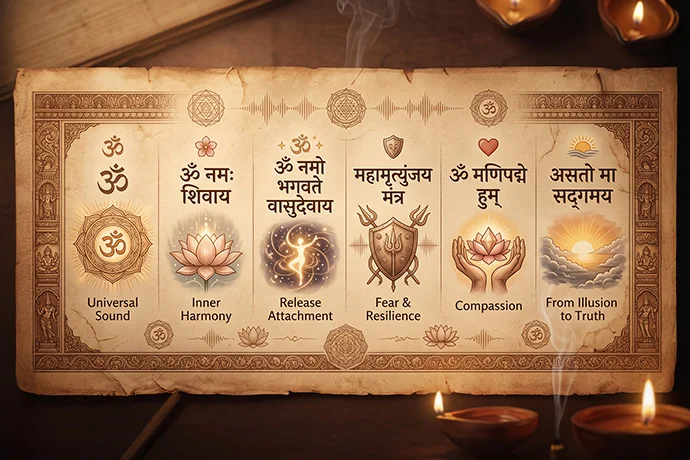
Powerful chants like “Om Namah Shivaya” are thought to create harmony within an individual’s mind as well as in the five elements, and “Om Namo Bhagavate Vasudevaya” is a chant that provides release from concerns related to the material world. The Shanti Mantras have a peaceful effect on the body, mind, and spirit; they can help promote relaxation and aid in overcoming insomnia.
Examples of inspiring mantras are “Om Asato Ma Sadgamaya,” which encourages an individual to transition from illusion to reality, and “Om Mani Padme Hum,” which promotes compassion for self and others and encourages a sense of inner peace.
The “Maha Mrityunjaya Mantra” is one of the most powerful mantras for overcoming fear, releasing stress, and negativity. Even listening to these sacred chants mindfully can create profound healing, clarity, and inner stillness.
1. Studies carried out by the Department of Psychology and the Department of Cognitive Science at Macquarie University suggest that chanting meditation can positively influence mood, emotional well-being, and social connectedness among individuals.
It is believed that regular chanting of mantras helps ease the symptoms of depression, anxiety, and stress. Although chanting is considered a pervasive practice, there’s little understanding of what psychological, emotional, social, and spiritual implications it has on an individual.
Scientifically, researchers have found that chanting mantras helps diminish negative thought patterns, anxiety levels, and stress because they help to calm the nervous system and, therefore, improve an individual’s ability to control their emotions. The research using an EEG and MRI has also demonstrated that there are changes in brain activity, and that there is less mental arousal and more relaxation when an individual engages in mantra meditation.
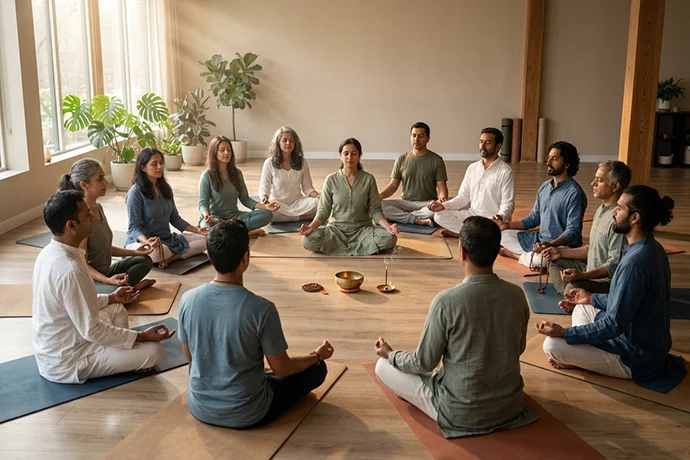
Chanting and meditative practices performed in groups are also thought to contribute to a sense of social connectedness or collective harmony between individuals participating in the chant; however, researchers have indicated that there is currently insufficient evidence to know how long-term the benefits of chanting mantras will be, or through what mechanisms chanting performs the above functions, as additional studies need to be completed to obtain scientifically valid evidence that demonstrates the presence of these benefits.
2. In a study published in the Journal of Affective Disorders Reports, 2021, researchers performed a randomized controlled trial to measure the added value of mantra meditation in combination with standard psychiatric treatment for individuals experiencing episodes of major depression.
Within an inpatient sample of 123 participants confirmed to have major depressive disorder, the patients were randomly assigned to two groups: one received standard psychiatric treatment and was offered mantra meditation; the other group had standard treatment and was provided with progressive muscle relaxation techniques.
Each participant attended guided sessions of 30 minutes twice each week and practiced daily. The results indicated that those in the mantra meditation group experienced a larger reduction in depression symptoms than those in the PMR (Progressive Muscle Relaxation) group at the 3-month and 6-month follow-up.
The researchers noted that the most notable decrease in symptoms seemed to be related to mood and emotional issues as compared to cognitive issues. Because of these results, the authors of the study concluded that mantra meditation has the potential to complement clinical treatment of major depression; however, larger studies need to be conducted.
Conclusion
As stated above, reciting mantras may serve as a form of practice in which an individual’s focus may aid in reducing their stress levels due to the ability to stop negative thoughts from occurring repeatedly and hold the mind in place, allowing them to be more emotionally stable.
Based on current research data on the relationship between chanting mantras and their relationship to how they affect the body and mind, it is reasonable to assume that chanting mantras may help improve an individual’s ability to control their emotional state.
Maintaining an individual’s emotional well-being consists of three major components: physical, psychological, and social.
Thus, the best way to successfully treat a person suffering from anxiety and depression is to provide a combined approach of all of the above and develop an individualized treatment to achieve this emotional balance, for example, counselling, psychotherapeutic treatment, and medication, while providing assistive therapeutic interventions (i.e., art, dance, mindfulness, etc) that would foster the individual’s emotional balance.
Mantras can also be a part of this larger system, where they can be beneficial for people looking to develop a sense of calmness/focus, but are not designed to serve as a replacement for the support of mental health professionals or any of the other recognized forms of therapy.

