

If you live in Mumbai, you already know the soundtrack to daily life: sharp horn blasts, crowded trains, bumper to bumper traffic, and people everywhere. Most days, I found myself getting frustrated. Every time a driver leaned on their horn for no good reason, my blood pressure spiked. I caught myself constantly blaming the city. How am I supposed to concentrate? How can anyone be at peace with all this madness outside?
My working theory was simple: if only things around me were quiet, my mind would be quiet too.
Then, I visited the Matrimandir in Auroville, near Pondicherry.
Before you go in, you watch a short video about the vision behind it, behind Auroville, a place dedicated to peace and human unity.
Auroville was founded in 1968 by Mirra Alfassa, known simply as The Mother, who was the spiritual collaborator of Sri Aurobindo, one of India’s most visionary philosophers and a monumental icon of modern yoga.
Sri Aurobindo famously taught that “All life is Yoga.” He rejected the old idea that spiritual realization requires escaping into caves or leaving the messy world behind. Instead, his Integral Yoga aims to transform human consciousness right in the middle of active daily existence. The Mother envisioned the Matrimandir not as a traditional temple bound by any religion, but as the silent “soul of the city”, a tribute to the Universal Mother and a space for human unity.
After the video, a shuttle drops you off, and the staff gently but firmly lay down the rules. The biggest one?
Absolute, unbroken silence.
Once you enter the golden dome and step into the inner chamber, not a single sound is allowed. If you have to cough or clear your throat, you are politely asked to step outside and come back when you’re done, just so the silence isn’t broken for anyone else.
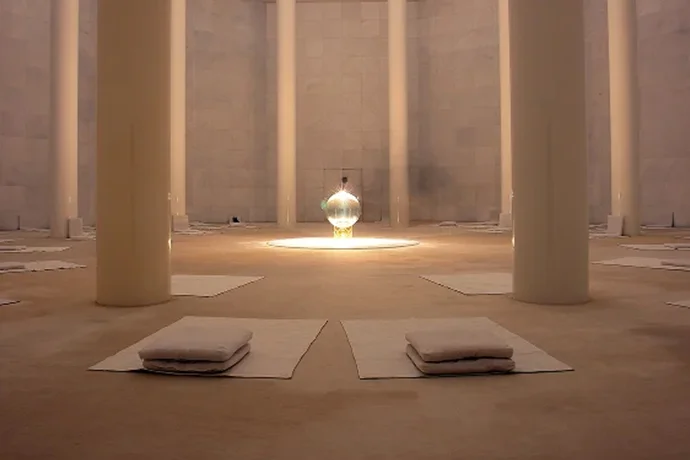
Walking into that inner chamber is unreal. Everything is pure white marble. There are no idols, no rituals, no religious chants. At the very center sits a giant crystal sphere, lit up entirely by a single ray of natural sunlight directed from the roof.

We were given fifteen minutes to sit and concentrate.
I thought, This is it. Finally, total silence. Now I’ll experience absolute peace.
I closed my eyes. And that’s when reality hit me.
The room didn’t have a single whisper, but inside my head, it felt like rush-hour traffic. My thoughts were racing from one random worry to the next. The external world had zero noise, yet I had zero calm. In fact, without the city’s distractions, my internal chatter felt even louder. My old theory completely collapsed: a quiet place does not give you a quiet mind.
Sitting there in frustration, a foundational Sanskrit line surfaced in my thoughts:
योगश्चित्तवृत्तिनिरोधः
Yogas Chitta Vritti Nirodhah
“Yoga is the stilling of the fluctuations of the mind.”
In Sage Patanjali’s Yoga Sutras, this is the very definition of yoga. Chitta is your mind, and Vrittis are the endless whirlpools of thoughts, worries, and reactions running through it. The Sutra basically says: Yoga is the stilling of the fluctuations of the mind.
Silence wasn’t something the white marble walls could give me. It had to come from within. Remembering that Pranayama (breath regulation) is one of the key limbs of this path, I stopped trying to force my mind to empty out. Instead, I just brought all my attention to my breath, the simple, steady rhythm of inhaling and exhaling.
And it worked. The racing thoughts gradually slowed down. The mental clutter faded. For the first time all day, there was genuine calm.
After those fifteen minutes, I spent another hour sitting quietly across three of the meditation “petal” rooms around the dome. Before leaving, I stood beneath the massive, ancient banyan tree near the entrance, hugged its trunk, and took in the grounding energy of the place.
Walking away, everything clicked.
We spend our whole lives waiting for our surroundings to be ideal before we allow ourselves to be happy or relaxed. But if you live in a bustling metro, waiting for the outside world to turn down the volume means waiting forever. The noise on the road isn’t what takes away your calm; it’s your reaction to it.
The center is never out there in a remote building or a silent room, it’s right behind your ribs, riding on your breath.
If we can teach this simple truth to ourselves, and especially to our kids growing up in fast-paced cities, we won’t need to run away from the crowd just to catch a breath of peace.

