
“Through practice of the limbs of Yoga, whereby impurities are eliminated, there arises enlightenment.”
– Yoga Sutras of Patanjali
Yoga is more than just asana practice; it goes beyond the physical aspect of it. It is a complete way of life rooted in self-awareness and inner transformation. In ancient times, sage Patanjali composed the Yoga Sutras, a systematized range of practices designed to awaken the innate potential within the human system. These sutras teach you to practise yoga on a mental, physical, and spiritual level. In Yoga Sutras, there is a mention of eightfold path, known as Ashtanga, meaning “eight limbs” (Ashta= eight, Anga=limb). These eight principles outline what one ought to be doing if one intends to live a life that is both fulfilling and balanced. These principles provide a basis for developing ethical decision-making abilities, strengthening self-discipline, and raising awareness of oneself in daily activities. In addition, these principles help people understand how to make healthy choices and protect themselves from unhealthy choices on all levels (physical, mental/emotional/spiritual).
Let us now dive into the eight limbs that form the foundation of Sage Patanjali’s yogic philosophy : –
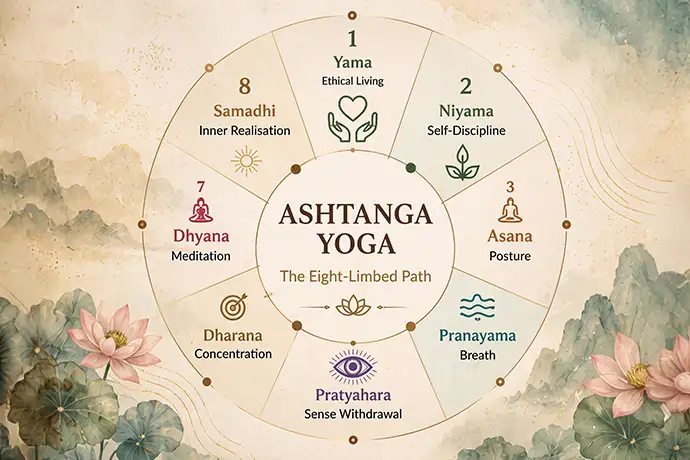
1) Yama (Universal Moral Commandments): Yama represents the moral discipline that guides our consciousness in the world. It also controls a yogi’s passions and emotions to keep him in harmony with his fellow man. Yama has four principles as following:
- Ahimsa (non-violence)
- Satya (Truthfulness)
- Asteya (non-stealing)
- Brahmacharya (Moderation and thoughtful use of energy)
- Aparigraha (non-possessiveness)
Together, these principles support the development of virtue, self-control, compassion towards others, and balance in living an ethical yogic lifestyle.
2) Niyama (Self-Purification by Discipline): Just like Yama, Niyama also focuses on emotions. It focuses on inner growth and self-discipline. It includes purity (Shaucha), contentment (Santosha), disciplined effort (Tapas), self-study (Svadhyaya), and surrender to a higher consciousness (Ishvara Pranidhana).
3) Asana (posture): Asanas are the physical postures practised in yoga. Regular practice helps improve concentration, reduce distractions, build physical strength, and bring balance to the body and mind. They also support the healthy functioning of the nervous system and encourage overall well-being. When practised under proper guidance, asanas may also help reduce anxiety and promote mental calmness.
4) Pranayama (rhythmic control of the breath): This stage teaches individuals to regulate breathing and thereby control the mind. Through specific breathing techniques, practitioners learn to balance Prana (life energy force). The inhalation (Pūraka) stage is where you inhale through your nose by drawing air into your lungs in a controlled fashion, with the second stage being holding the breath (Kumbhaka). When you hold your breath for as long as you can or need to, you allow yourself time to absorb as much oxygen into your body as possible, which also helps increase your overall lung capacity. The third stage is exhalation (Rechaka), which is to take all of the air out of your lungs by slowly and completely releasing the air out of your mouth. Prāṇāyāma offers many benefits when practiced correctly, but improper practice without guidance may cause dizziness, headaches, or breathing issues. Proper supervision helps ensure safety, correct technique, and maximum benefits.
5) Pratyahara (withdrawal and emancipation of the mind from the domination of the senses and exterior objects): Pratyahara and Pranayama stages are also known as inner quest (Antaranga Sadhana). In this state, the mind remains unaffected by external distractions, allowing the senses to focus entirely on the chosen object. While this may be challenging, you can achieve it through focused actions and practicing continually to build your strength and focus on what you are trying to accomplish.
6) Dharana (concentration): This stage takes the yogi into the innermost recesses of his soul. It is a mental state that involves focusing or concentrating the mind (Chitta) on an object you want. An object can be something physical that is your body, or how you feel, or something outside you (like the moon or a representation of a deity). Concentrating means holding your attention on one thing as you would if you were looking at the tip of your nose, or between your eyebrows, or your chest area, or a representation of a deity. To concentrate means to hold your attention so that it is steady and still, like a flame of a candle that doesn’t flicker. Concentrating on one type/object of that concentration to do one thing and not to get distracted is a major step in how a person advances in yoga.
7) Dhyāna (Meditation): Dhyāna is a state of deep, continuous meditation where the mind constantly focuses on one object without engaging in distractions. Meditation produces a calm, clear mind and decreases distraction, thereby improving concentration; relieving negative energy; and fostering mental stability and inner peace through chanting mantras and sound vibrations. By profound meditation, the knower, the knowledge, and the known become one. The seer, the sight, and the seen have no separate existence from each other. It is like a great musician becoming one with his instrument and the music that comes from it.
8) Samādhi (Super Consciousness)- A state where super consciousness is brought about by profound meditation, in which the individual aspirant (Sadhaka) becomes one with the object of his meditation or the universal spirit. The most elevated level of yoga is called Samādhi. When someone reaches Samādhi, their mind is wholly consumed by what they are concentrating on. With Dhyāna, a state of awareness has been achieved, but there is still a sense of duality; this is not true in Samādhi, where only pure awareness exists. Samādhi is also part of Sāmyama, which includes Dhārana and Dhyāna and provides a path for gaining great wisdom, increasing concentration, and attaining spiritual realization.
The Role of the Eight Limbs in Modern Living
| Limb | Daily Practice |
| Yama | Practice kindness, honesty, and non-harming in your interactions. |
| Niyama | Maintaining personal discipline and regularity in practices. |
| Asana | 20–30 min yoga movement and holding the pose. |
| Pranayama | 5 to 10 minutes of conscious breathing exercises. |
| Pratyahara | Reduce screen time, minimise sensory distractions, and spend a few moments in quiet reflection. |
| Dharana | Practice focused attention on a single object, your breath, or a mantra. |
| Dhyana | Dedicate 10–20 minutes to a calm and focused meditation practice. |
| Samadhi | Allow deep inner peace to emerge naturally through consistent practice. |
Conclusion
The fast-paced, distracting world we live in today can be extremely overwhelming. However, if you desire to find balance, become more self-aware, and live a disciplined and peaceful life, then consider The Eight Limbs of Yoga as a guide to follow. The Eight Limbs of Yoga are not just the physical postures you do in class – they can also serve as practical tools for living in a clearer, more compassionate, and peaceful manner. By practicing the Eight Limbs of Yoga– ethical living, self-discipline, meditation, and spiritual growth- individuals can reconnect with their true selves even in this chaotic environment we live in today. Individuals can incorporate these principles into their daily lives at their own pace to create a healthier state of mind, a more peaceful state of being, and a more meaningful way to live.
References:
- Light on Yoga: Yoga Dipika / B.K.S. Iyengar

