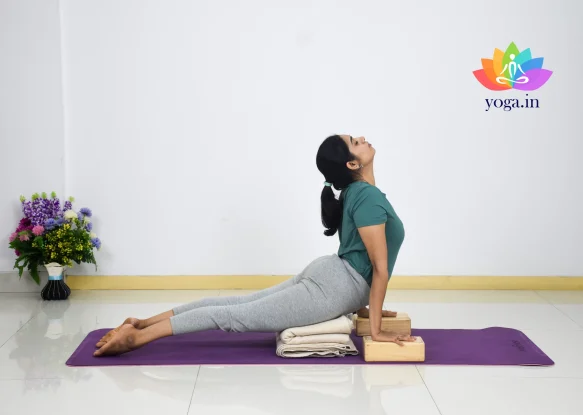
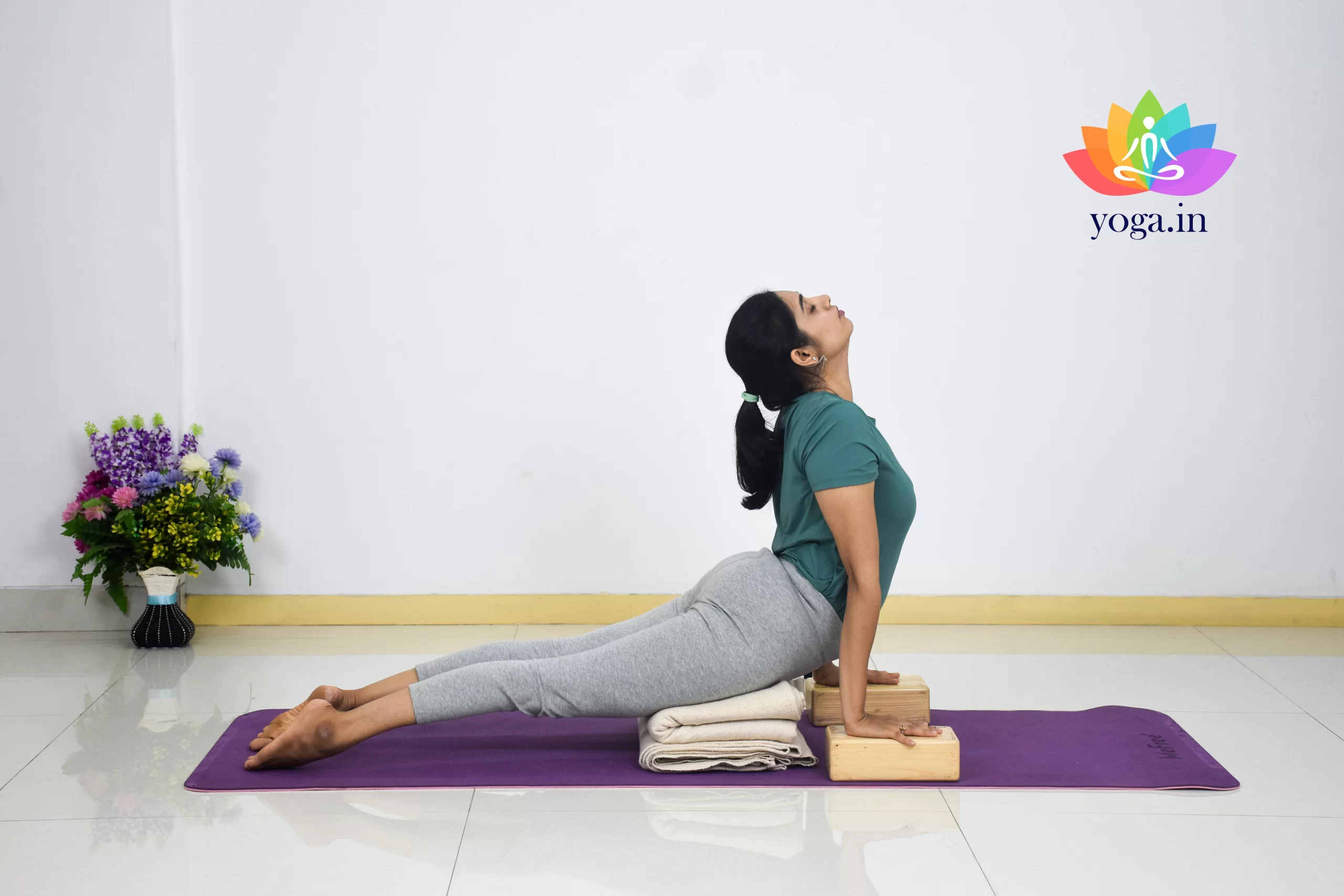
The Sanskrit name is derived from ऊर्ध्व Urdhva, “upwards”; मुख Mukha, “face”; and श्वान Shvana, “dog”.
Place a yoga mat on the floor.
Fold a blanket and place it on the mat where your pelvis and thighs will rest.
Position two yoga bricks at the front of your mat.
Begin by lying on your stomach (prone position) on the mat.
Extend your legs straight behind you, with the tops of your feet pressing into the mat.
Lift your pubic bone toward your navel to support your lower back.
Place your pelvis and thighs on the folded blanket for added support and cushioning.
Place your palms flat on the yoga bricks, fingers spread wide and pointing forward.
Ensure that your hands are aligned with your lower ribs.
Keep your elbows close to your body by pointing backward, not flaring outward.
Press your hands firmly into the yoga bricks and engage your shoulder blades by drawing them down and back.
Lift your chest slightly forward to open your heart.
Press the tops of your feet firmly into the mat and engage your leg muscles.
Lift your kneecaps off the mat and keep your thighs active and lifted.
Roll your thighs inward slightly and engage your lower abdominal muscles.
Inhale and begin to straighten your arms, lifting your chest and upper body off the mat.
Keep your shoulders away from your ears and broaden across your collarbones.
Keep your neck in a neutral position, neither straining upward nor dropping downward.
Your gaze can be forward or slightly upward.
Engage your core muscles to support your spine and stabilize your torso.
Avoid sinking into your lower back.
Maintain steady and controlled breathing throughout the pose.
Hold the pose for several breaths, maintaining the alignment and engagement of muscles.
To release, exhale and gently lower your chest back to the mat and relax yourself.
Ensure that your elbows are close to your body and pointing backward, not flaring outward.
Engage your leg muscles, lifting your kneecaps off the mat. Keep your thighs active and lifted.
Collapsing the shoulders
Overarching the neck muscles
Locking out the elbows can strain the joint and overstretch the ligaments
Lack of core engagement
Avoid in case of chronic back Injury or surgery
Avoid during pregnancy
Avoid in Carpal Tunnel Syndrome
Avoid in case of high blood pressure
The Sanskrit name comes from the Utthita,
The Sanskrit name is derived from Utthita
The name comes from the Sanskrit, Utthita,
The sanskrit name is derived from sirsa
The name is derived from Ushtra (उष्ट्रासनI)
The Sanskrit name is derived from Tada
Please login with social account to support this post.